Posts

Showing posts with the label Religious

THE STORY OF GAJENDRA MOKSHA
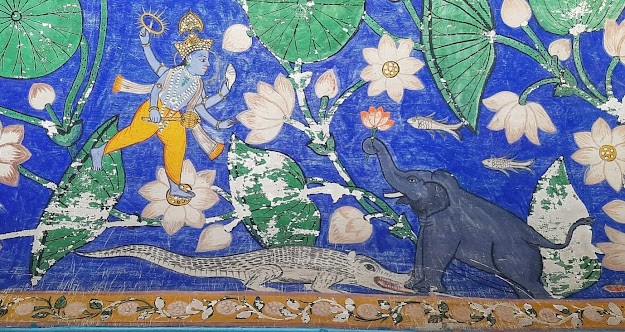
Image
Name of story: The Story of Gajendra Moksha  Name of place: Shree Raghunath Temple, Bhindar, Udaipur Article written by: Laxmi Kanta Saini Edited by: Shreeya Rawat   सोsन्तस्सरस्युरुबलेन गृहीत आर्त्तो दृष्ट्वा गरुत्मति हरि ख उपात्तचक्रम। उत्क्षिप्य साम्बुजकरं गिरमाह कृच्छा – न्नारायण्खिलगुरो भगवान नम्स्ते॥३२॥ The story of Gajendra Moksha or the liberation of Gajendra is a puranic legend from the eighth  skandha of Bhagwata Purana , one of the most sacred books in Hinduism. The episode of Gajendra Moksha holds a significant place in Vaishnavism and has great symbolic value for Vishnu devotees. The theme based on mythological stories of Vishnu is mostly found in the temples of Vaishnava communities. The story is depicted very vividly on the walls of Shree Raghunath Temple in Bhindar tehsil of Udaipur, Rajasthan. The story is depicted in bright colours on the ceiling of the temple, with a predominant use of blue in the background representing the water. Delicate o...
PAINTINGS OF VIRUPAKSHA TEMPLE

Image
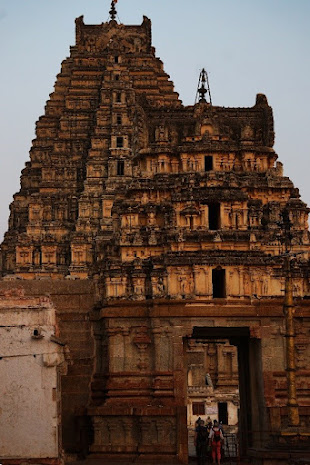
Site name: Virupaksha Temple, Bellari, Karnataka Article written by:  Shreeya Rawat   PAINTINGS OF VIRUPAKSHA TEMPLE The Virupaksha Temple or the Lokeshwara Temple dedicated to Lord Shiva is situated at Hampi in the Bellari district of Karnataka. ‘ Virupa ’ means ‘no form’, and ‘ aksha ’ means ‘eyes’, hence Virupaksha, a name for Lord Shiva, literally means eyes without any form. The temple is built in the Dravidian style of architecture and is located along the southern bank of the Tungabhadra River. The temple is a part of the Group of Monuments at Hampi, designated as a UNESCO World Heritage Site. Lakkan Dandesha, a Nayaka chieftain under the rule of Deva Raya II of the Vijayanagara Empire built this temple in the 7th century C.E. Later additions were made to the temple structure during the late Chalukyan and Hoysala periods. It is one of the oldest living temples in Hampi. The ceiling of the ranga mandapa of the temple houses wall paintings made in tempera technique....

DASHAVATARS OF LORD VISHNU

Image
Name of story: Dashavatars of Lord Vishnu Site Name: Ganesh Ghat Mandir, Alwar, Rajasthan Article by: Shreeya Rawat DASHAVATARS OF LORD VISHNU A Kachwaha Rajput ruler, Pratap Singh established the Princely State of Alwar in 1770 C.E on the eastern side of the Aravali range. The  Ganesh Ghat Mandir in village Lalpura (Alwar district) is built in the traditional  haveli  style and houses beautiful wall paintings. The temple showcases Rajput architectural features. A series of steps leads to the entrance of the temple. The structure houses two hexagonal  chhatris  (dome shaped pavilion) on both the sides of the staircase. The temple is approached through a multi-cusped arched gateway with  gokhas  (arched sit-outs) on either side. The single-storey structure is crowned with a  bangladhar   roof (gable roof). The centre of the courtyard houses the temple dedicated to Lord Shiva. The temple of Lord Ganesha on the first floor is connect...
Image
Name of story:  Paintings of Hanuman Temple, Alwar Site name:   Hanuman Temple, Alwar Article by:  Shreeya Rawat PAINTINGS OF HANUMAN TEMPLE, ALWAR   Hanuman Ji ka Mandir is situated at Agar village in Alwar district of Rajasthan. The temple was constructed in the 18 th century and is built on a rectangular plan. The temple hall has a three-bay entrance with semicircular arches and a cornice which is used for conducting prayers. It is divided into two sections by a huge semi-circular arch. The walls of the hall and the ceiling of the Shiva temple are adorned with some beautiful paintings.  The paintings of this temple belong to the Rajasthani Dhundhar School of art having a combination of both Rajput and Mughal elements along with a tinge of local art styles. These paintings are made in the tempera technique in which pigments are mixed with a binding medium and applied on a dry lime plaster. The walls of the prayer hall are decorated with 24 incarnation...

Shabari's Devotion to Lord Rama

Image
Title: Shabari’s Devotion to Lord Rama Survey date: 30th June, 2017 Surveyor Name: Anjali Araj, Laxmi Kanta Saini and Nurul (Wall Painting Directory, Jaipur) Site name: Shri Sitaram Ji Maharaj Ka Mandir, Tonk, Rajasthan Article by: Shreeya Rawat (Wall Painting Directory, INTACH, New Delhi) T he region of Tonk remained the capital of the Princely States of British India from 1817 to 1947. Its rich culture is reflected in the folk arts and traditional paintings. The temple of Shree Sitaram Ji Maharaj is situated in a small tehsil of Malpura of Tonk district which is approximately 60 miles from south of Jaipur. The temple can be reached from Tonk bus stand and Niwai Railway Station. The temple was built under the patronage of Nawab Ameerudullah. Built in 19th century in the traditional haveli style of Rajasthan, the temple houses beautiful wall paintings painted in the alagila technique. Alagila paintings are laid on fresh lime plaster with pigments mixed with a binding medium. Later on, ...

The Medicine Buddha

Image
Title: The Medicine Buddha Site name : Phu Monastery, Lahaul Spiti, Himachal Pradesh Survey date : 25-07-2016 Surveyor Name:  Anoop Thakur, Manjula, Sanjeev, Ramlok, Devender, Yograj Article by: Ms Garima Tomar (Project Assistant, INTACH) wall painting panel depicting the Medicine Buddha in the centre “If one meditates on the Medicine Buddha, one will attain enlightenment, but in the meantime, one will experience an increase in healing powers both for oneself and others and decrease in physical and mental illness and sufferings” ... Lama Tashi Namgyal. Medicine Buddha is also universally known as Bhaisajyaguru in Sanskrit, whereas Bhaisajya means “curativeness” or “healing” while guru means “teacher” or “master”. He is also widely known as Bhaisajyaraja, raja meaning “king”. As the name suggests, the medicine Buddha is associated with healing. Medicine Buddha sutra gives the finest description of the Medicine Buddha and the 12 vows taken by the Buddha after attaining the...